


Be first to read the latest tech news, Industry Leader's Insights, and CIO interviews of medium and large enterprises exclusively from The Cyber Security Review
The Cyber Security Review: Specials Magazine
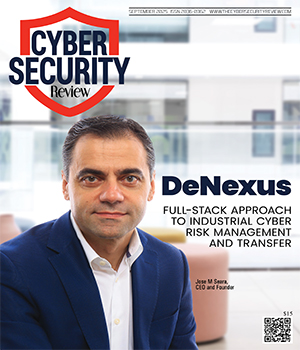
Operational technology (OT) systems have always been built for resilience, ensuring operations never stop. However, decades ago, that goal was always fortifying against physical bad actors rather than cyber threats. Originally built to operate in isolation, factory systems were never meant to face the internet, support remote access, or withstand relentless cyber threats. Now, as these legacy systems become increasingly integrated and networked, they face exposure that their original designers never anticipated. The result is a growing challenge: industrial cyber risk, a threat that conventional IT security can’t solve. Six years ago, Jose M Seara, CEO and founder of DeNexus, was on the receiving end of these very risks. “I was running a company with OT infrastructures that were exposed to industrial cyber risks and grew frustrated by the absence of effective cyber risk management tools to measure, manage, and mitigate that risk,” says Seara. “That pain point became the foundation for DeNexus’ creation.” Since its inception, DeNexus has helped Global 1000 companies reduce their cyber risk through DeRISK™. This is an evidence-based, full-stack cyber risk quantification platform that translates cyber threats into financial terms, enabling end-to-end risk management for industrial organizations. It gives them clear visibility into their facilities' cyber exposure and quantifies both the likelihood and economic impact of potential incidents. The platform also enables them to prioritize mitigation efforts based on ROI and business goals efficiently
Top OT Cybersecurity Consultants 2025
Efficiency in critical infrastructure now hinges on a delicate balance between IT systems and operational technology. The convergence of these two layers has become central to how industries operate, as speed, responsiveness, and cost control all depend on it. However, while the digital layer evolves quickly, the physical systems underneath often do not. Many organizations still rely on aging equipment that was never built to connect with modern networks. Much of it is undocumented. And the people who once installed and managed it? They have already left the workforce. That knowledge gap, combined with growing digital exposure, creates costly blind spots hidden across refineries, pipelines, water systems, and transit networks. Companies often cannot say with certainty what equipment is installed, how it communicates, or where it might be vulnerable. Audits, compliance deadlines, and rising threats place added pressure on teams that are already stretched thin. UTSI helps organizations make sense of this complexity. What began as a control room systems integrator 40 years ago now plays a global role in protecting critical infrastructure. UTSIs work spans oil and gas, renewables, power generation, transportation, and public utilities. Its team supports companies that run complex, often undocumented environments where security gaps are easy to miss and difficult to fix. Technical Chops To Take On Any Challenge “UTSI has embraced technology, including AI, and uses tools like Fortinet, Nozomi, and FRENOS (a native AI platform), which scan control systems and generate a digital map of the network by identifying each connected device, access path, and weak point,” says Shaun Six, president. Many clients operate with legacy equipment, so the process often reveals systems no one realized were still active. Once the network is visible, the team documents vulnerabilities and builds a cybersecurity roadmap using frameworks such as NERC CIP or IEC 62443 to structure their recommendations..

AI Cybersecurity Solution 2025

In today’s cybersecurity landscape, traditional solutions often fall short of preventing complex attacks and ensuring comprehensive protection. Organizations grapple with undetected malware, ineffective firewalls, and long-standing vulnerabilities that remain unresolved. Additionally, many security providers impose high fees as data usage grows, driving up costs while offering limited peace of mind. Addressing these critical gaps requires a cutting-edge solution that combines Cognitive AI-driven threat detection and prevention with a unique, on-premises approach, delivering real-time responses without the risk of a single point of failure. Canfield CyberDefense Group is redefining the field with its innovative, privacy-focused, customer-centric approach, setting a new standard for cybersecurity excellence. Unlike competitors who charge based on data volume, usage time, or other metrics, Canfield provides a transparent pricing model that charges by the number of IPs, and real-time data storage offering volume discounts for large-scale users. This “no-pickpocket” approach reflects their commitment to integrity in pricing. Canfield CyberDefense Group further distinguishes itself with its on-premises architecture. Unlike many providers that rely on cloud-based solutions with potential single points of failure, Canfield’s system is deployed within a closed network, ensuring that customer data remains entirely on-site. Data does not reach back to the vendor site. “Our model addresses a growing concern for organizations—data privacy. Today, breaches and privacy issues are becoming increasingly common. We offer a solution that ensures sensitive information stays within the organization, providing a higher level of security than many cloud-based alternatives,” says Rosy Canfield, president and CEO of Canfield CyberDefense Group. At the core of Canfield’s offering is a sophisticated combination of artificial intelligence (AI) and machine learning (ML), referred to as “cybernetic.” Unlike traditional solutions that depend on preset baselines, Canfield’s platform can establish a network’s baseline in just 15 minutes, showcasing the speed and efficiency of its deployment. The AI-driven platform goes beyond basic detection, employing advanced knowledge representation and real-time actions that mimic human decisionmaking. The company’s adaptability allows it to provide an “active response” to cyber threats, contrasting sharply with competitors who rely on passive or reactive measures. Another key differentiator is Canfield CyberDefense Group’s approach to network architecture. Unlike cloud-based systems that could lead to widespread issues if a single client is compromised, its solution operates in a distributed, clustered environment. This decentralized model ensures each client’s system functions independently, reducing the risk of a broad impact during a breach—particularly important in industries such as finance and healthcare, where even minor security lapses can have severe consequences. Furthermore, updates and patches are handled individually rather than universally, enhancing both stability and security.
CXO INSIGHTS

Enhancing Cyber Risk Management: Integrating Mitre Att&Ck, Fair, And The Nist Framework
Albert Evans, Director, Chief of Information Security, ISO New England Inc

Building a Business-Driven Cybersecurity Strategy
Jerry Gentry, VP - Infrastructure and Security, New Fortress Energy

Navigating Cybersecurity in a Rapidly Evolving World
Casper Eloff, Head of Corporate Security, The Mosaic Company

Adapting Security with Clear Risk Awareness and Team Support
Patty Ryan, Chief Information Security Officer, QuidelOrtho

Cybersecurity Leadership: Building Resilience in a High-Stakes Digital World
Tim Johns, Vice President Information Technology, Custard Insurance Adjusters

Preparing for Q-Day: Why CIOs Must Act Now on the Quantum Threat
Fabian Schramke, Sr. Director Information Security, Newrez LLC

Building Scalable Security: A Framework for Stability, Innovation, and Growth
Viraf Machhi, Director of Cyber Engineering & Security Architecture, MGM Resorts International


IN FOCUS

Enhancing Resilience: Cybersecurity Strategies for Operational Technology
Operational technology cybersecurity is crucial for safeguarding industrial systems against unique threats. Consultants enhance security through ongoing risk assessments, compliance, and bridging IT-OT gaps for long-term resilience.

Strategic Evolution of Industrial Cyber Risk Management Solutions
The growing market demand and profound impact of effective cyber risk management underscore its role as a cornerstone of modern industrial resilience.
EDITORIAL
Protecting Industrial Operations From Evolving Cyber Threats
The cybersecurity industry is booming, driven by the growing frequency and sophistication of cyberattacks across all sectors. The rise of IoT-enabled machinery expands the attack surface, while smart factories introduce new digital vulnerabilities. Real-time data monitoring and predictive analytics offer efficiency but create potential entry points for attackers. Cloud integration and remote access tools streamline operations but require stronger security controls. Industrial Cyber Risk Management Solutions and OT cybersecurity consultants help organizations navigate these challenges. By assessing vulnerabilities, implementing tailored defenses and aligning IT and OT security strategies, they protect critical infrastructure, ensure operational continuity and safeguard business reputation against an evolving threat landscape. This edition of The Cyber Security Review highlights recent developments in industrial cybersecurity, exploring the latest strategies, technologies, and best practices that help organizations stay ahead of evolving threats. It features thought leadership articles from industry experts, including Richard Mendoza, director, business unit information security officer at Realogy Holdings Corp, who emphasizes that ethical AI development, strong data security, transparency, and adherence to regulations are crucial for leveraging AI’s benefits. Mark Dunkerley, Mark Dunkerley, director at The Coca-Cola Company, underscores that humans remain the weakest link in security, noting that most breaches stem from human error or misuse. We hope this edition helps you gather valuable insights into protecting industrial operations, managing cyber risks, and implementing emerging cybersecurity technologies securely to stay ahead of evolving threats.
